sgslt@sgslt.com
+91 231 3501000
sgslt@sgslt.com
+91 231 3501000
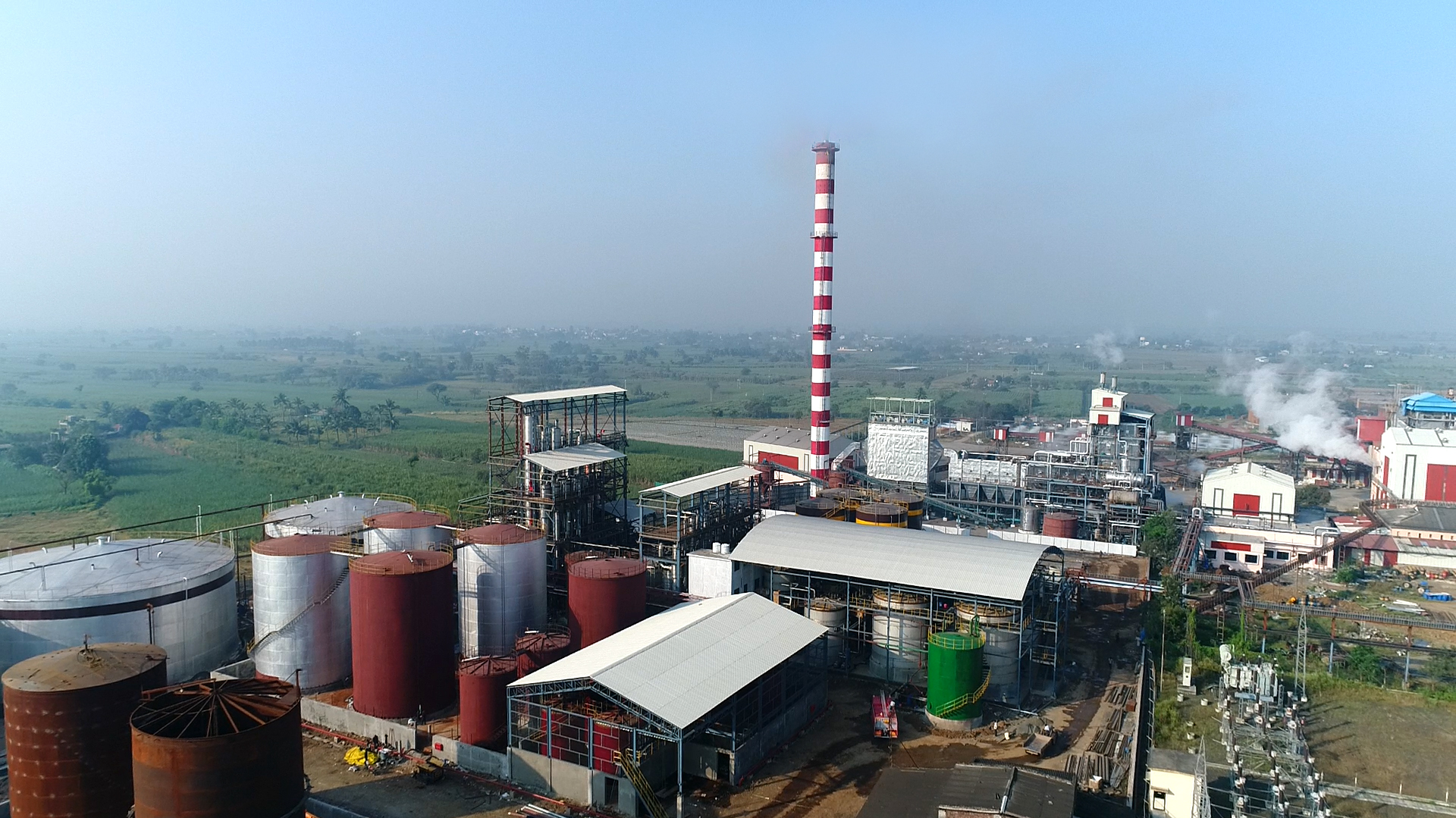
The Distillery plant having 200 KLPD Rectified Spirit/ Absolute Alcohol & 60 KLPD Extra Neutral Alcohol Plant.
Hi Ferm. GR- Fermentation with Multi-pressure vacuum Distillation, Integrated Evaporation and Stand Alone Evaporation Technology with Spent wash Concentration Incineration unit, Spent wash Dryer & Granulation to manufacture rich Potash as PDM Which is commissioned and commercial production in 2020 – 2021. In This system Conc. Spent wash goes up to 55 to 60 Deg. C. Which is used as a Fuel for Incineration Boiler.
In the second system the Raw Spent wash fed to Biodigester to produce 25000 Nm3/day Biogas.The outlet of Biodigester consider as Biomethanated Spent wash is treated in Integrated Evaporation & Standalone Evaporation.The Concentrated Spent wash of 35 – 40 % Solids are fed to Dryer to produce Potash Powder which contains 20 % Poatash as K2O which is then fed to Granulation to produce Potash Granules which contains mini. 14.5 % Potash as K2O.
The Plant has a capacity to Manufacture 66000 KL Rectified Spirit or 43900 KL Ethanol & 19800 KL Extra Neutral Alcohol (ENA) per annum.
The Absolute Alcohol plant is designed as a Molecular Sieve Technology. In this plant produced ethanol (anhydrous alcohol) is supplied to the OMC as per Government declared rate & in open market as per demand.
The Distillery Plant is supplied by S M Project Make M/S. Mojj Engineering Pvt Ltd. Pune.
Our Distillery is designed as one of the best Zero Liquid Discharge (ZLD) Incinerating the spent wash with Coal fired 22 TPH With ESP boiler supplied by Bikson make M/S. Thermax Ltd. Pune. and 2.0 MW Turbine supplied by M/S. Triveni Eng. Benglore & the Spent wash Dryer & Granulation supplied by M/S. Raj Process Pune.
Molasses → Dilution → Clarification / Pre-treatment → Fermentation → Fermented
Wash → Distillation → Rectification → Rectified Spirit (RS)
Rectified Spirit (RS) is produced from molasses through a controlled fermentation and distillation process.
Molasses is diluted with process water to achieve the required fermentable sugar concentration suitable for efficient fermentation.
The diluted molasses is subjected to suitable clarification and pre-treatment to remove undesirable suspended matter and to condition the feed for fermentation.
The fermentation medium is adjusted to the required pH and supplemented with essential nutrients to support healthy yeast growth and efficient alcohol production.
Yeast is propagated under controlled conditions and introduced into the fermentation system.
The fermentable sugars present in the molasses are converted by yeast into ethanol and carbon dioxide.
Typical fermentation period: approximately 30–40 hours, depending upon the process technology, feedstock quality and operating conditions.
At the completion of fermentation, the fermented wash generally contains approximately 8–12% v/v alcohol.
The fermented wash is transferred to the distillation section. Through controlled heating and separation in distillation columns, ethanol is separated from water and non-volatile components.
The alcohol-rich stream is further rectified to increase alcohol concentration and remove a significant portion of impurities and congeners.
RS → Rectification → Purification → ENA → Storage
Extra Neutral Alcohol (ENA) is produced by further purification and rectification of Rectified Spirit.
Rectified Spirit obtained from the distillation and rectification section is fed to the ENA rectification system.
The RS undergoes further fractional rectification to increase alcohol purity and reduce undesirable volatile and semi-volatile components. 3. Removal of Congeners
The rectification system is operated to separate and control impurities such as:
Careful control of the heads and tails fractions is maintained to achieve the required neutral spirit quality.
Further purification is carried out, as required by the product specification, to obtain high-quality neutral alcohol with controlled impurity levels.
The finished ENA is cooled, where required, and transferred to dedicated storage tanks under appropriate safety and quality-control conditions.
2.3 Typical ENA Specification
| SR. NO | CHARACTERISTICS | INDUSTRY SPECIFICATION |
| 1 | Specific Gravity @ 20 Oc | 0.8064 |
| 2 | Ethyl alcohol content % by volume at 20 oc/min | 96.0 |
| 4 | Alkalinity | NIL |
| 5 | Acidity gms/100ml | 0.00089 |
| 6 | Residue on evaporation, percent by mass, max | 0.005 |
| 7 | Fusel oil test ppm | 0-50 |
| 8 | P P time in minute mini | 30 MIN |
| 9 | Strength o.p | 68.0 |
| 10 | Acetaldehyde ,gm/100l of absolute alcohol | Max 0.5 |
| 11 | Acetone,gm/100l of absolute alcohol | NS |
| 12 | Ethyl acetate ,gm/100l absolute alcohol | Max 1.3 |
| 13 | Methanol ,gm/100l absolute alcohol | Max 50 |
| 14 | 2-Propanol ,gm/100l absolute alcohol | NS |
| 15 | Diacetyl ,gm/100l absolute alcohol | Min 50 |
| 16 | 2-Butanol ,gm/100l absolute alcohol | NS |
| 17 | 1-Propanol ,gm/100l absolute alcohol | NS |
| 18 | 2,3 Pentanedione ,gm/100l absolute alcohol | NS |
| 19 | n-butyl acetate ,gm/100l absolute alcohol | NS |
| 20 | lso-Butanol, ,gm/100l absolute alcohol | NS |
| 21 | 1-Butanol ,gm/100l absolute alcohol | NS |
| 22 | lso-amyl acetate ,gm/100l absolute alcohol | NS |
| 23 | Amyl+ lso-amyl alcohol ,gm/100l absolute alcohol | Max 30 |
| 24 | Total higher alcohol ,gm/100l absolute alcohol | NS |
| 25 | Furfural ,gm/100l absolute alcohol | NS |
Ethanol for fuel and industrial applications can be produced by dehydration of rectified spirit/alcohol feed.
RS / Rectified Spirit → Pre-heating → Molecular Sieve Dehydration → Anhydrous
Ethanol → Cooling → Storage
Feed Preparation
Rectified spirit or suitable alcohol feed having approximately 95–96% v/v alcohol is supplied to the dehydration section.
The feed is pre-heated to the required operating temperature before entering the dehydration system.
The pre-heated alcohol stream is passed through a molecular sieve dehydration system. Molecular sieves selectively adsorb water from the alcohol-water mixture.
The dehydration process removes the remaining water to produce high-purity anhydrous ethanol.
The dehydrated ethanol is cooled to the required storage temperature.
The finished ethanol is transferred to dedicated ethanol storage tanks and maintained under appropriate operating and safety conditions.
| SR. NO. | CHARACTERISTIC | INDUSTRY EOI SPECIFICATION IS 15464:2022 |
| 1 | APPEARANCE | CLEAN & BRIGHT AND FREE FROM SUSPENDED MATTER |
| 2 | RELATIVE DENSITY AT 15.6 °C/15.6°C MAX | 0.7956 |
| 3 | ETHANOL CONTENT % BY VOLUME AT 15.6°C/15.6°C MIN | 99.6 |
| 4 | METHANOL PERCENT V/V MAX | 300 |
| 5 | HIGHER SATURATED ALCOHOLS (C3-C5)V/V MAX | 1.5 |
| 6 | BOILLING POINT C MIN | – |
| 7 | RESIDUE ON EVAPORATION, PERCENT BY MASS, MAX | 0.005 |
| 8 | ACIDITY (AS CH3COOH),MG/I, MAX | 30 |
| 9 | ALKALINITY | NIL |
| 10 | ALDEHYDE CONTENT (AS CH3CHO)MG/I,MAX | 60 |
| 11 | ELECTRICAL CONDUCTIVITY 5/M MAX | 300 |
| 12 | COPPER, MG/KG, MAX | 0.1 |
| 13 | PHE | 6.5-8.0 |
| 14 | INORGANIC CHLORIDE | 3.0 |
| 15 | SULPHTE CONTENT MG/KG MAX | 4.0 |
| 16 | SULPHUR CONTENT MG/KG MAX | 10 |
| 17 | WATER CONTENT PERCENT V/V MAX | TO REPORT(NOTE2) |
| 18 | HYDROCARBONS PERCENT V/V MAX | – |
| 19 | MISCIBILITY WITH WATER | MISCIBLE |


